September 7th, 2026
Renke Keppens
Despite increasing automation, many jobs still depend on precise manual work. Think of assembling the tiny and delicate components needed to produce computer chips, handling materials in pharmaceutical production, or performing fine-grained actions during surgery.
In these environments, workers need to carefully coordinate what they see and think with what they do, often under time pressure and strict performance requirements. Even small mistakes can have serious consequences, ranging from costly production errors and wasted materials to potential safety risks.
As task instructions become more complex, workers need to process more information, plan more carefully, and devote greater cognitive resources to performing the task correctly.
In other words, increasing cognitive demands can increase cognitive workload (CWL): the mental effort needed to successfully perform a task. When these demands approach or exceed the cognitive resources available, performance may deteriorate, and mistakes can become more likely.
Being able to recognize when someone's workload is increasing could therefore be valuable, particularly if future training or support systems could adapt accordingly.
But how do we measure cognitive workload while someone is actually working?
Researchers often use questionnaires or physiological signals such as brain activity, heart rate, or pupil size. Yet there may be another source of information right in front of us: the movements of our hands themselves.
This called for a study!
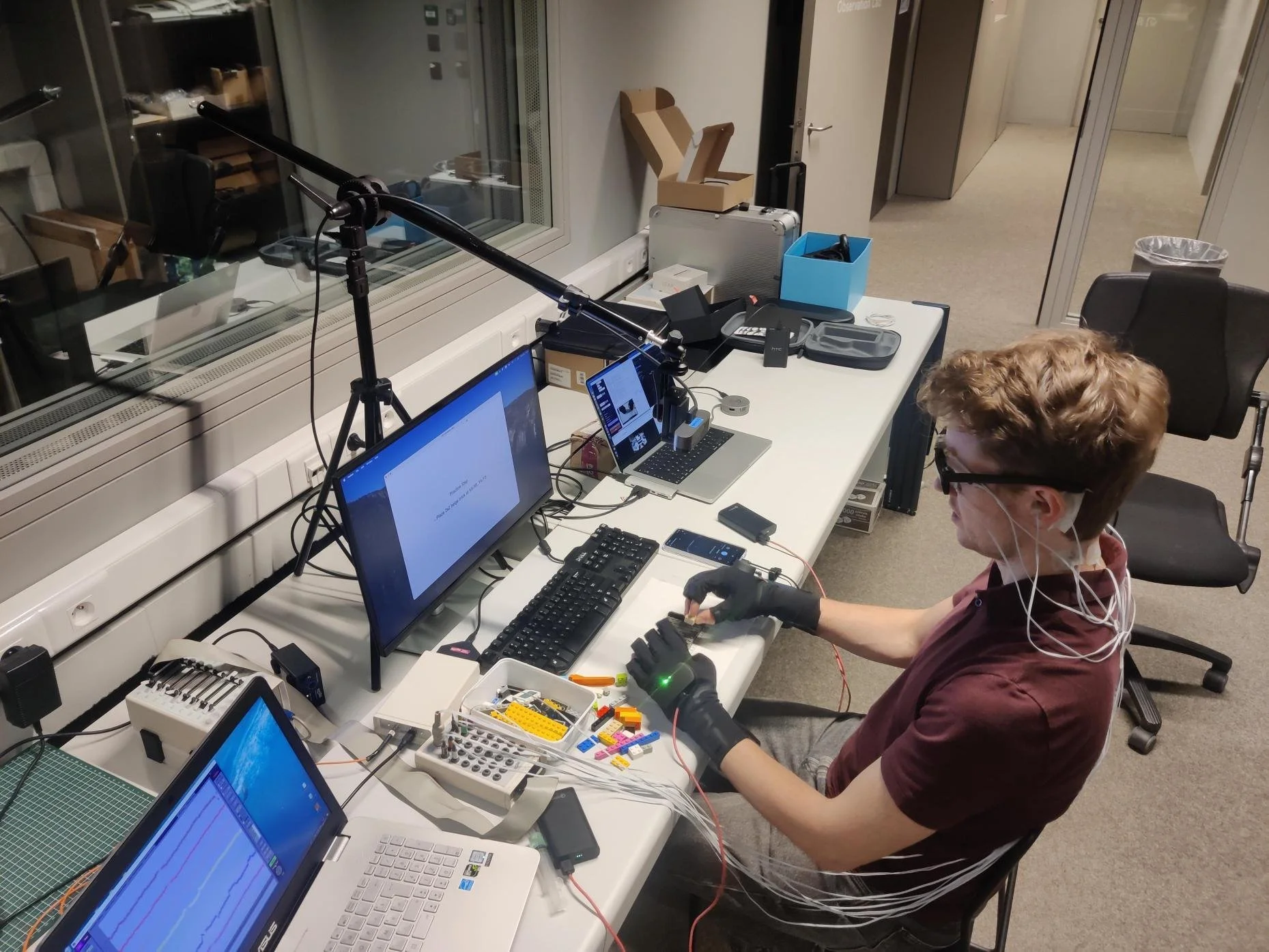
We asked 21 participants to build two LEGO assemblies while wearing motion-tracking gloves. To vary cognitive workload, we changed how the assembly instructions were presented. Sometimes participants received familiar visual LEGO instructions. At other times, they had to interpret written spatial instructions or even decode symbolic information before determining where a brick belonged.
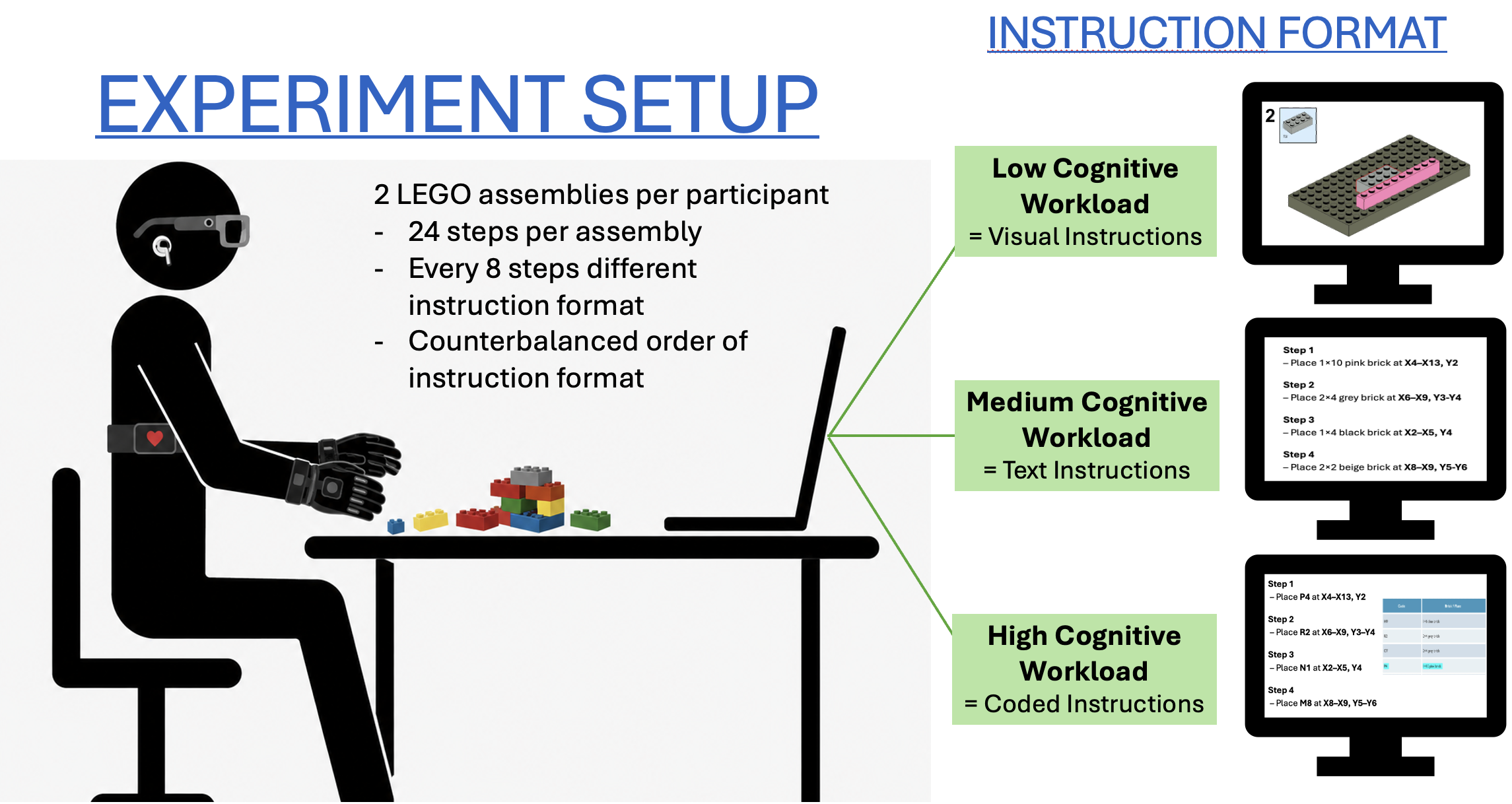
We then examined five aspects of their hand movements for each assembly step:
Movement velocity: How fast were the hands moving?
Movement distance: How far did the hands travel?
Freeze percentage: How much of the task time were the hands relatively still?
Freeze duration: How much time in total was spent relatively still?
Freeze frequency: How often did these moments of little or no movement occur?
Here comes the interesting part. With the more cognitively demanding instruction formats, participants moved more slowly, travelled greater distances, and froze more often and for longer. Participants who reported higher workload also tended to show the same general pattern in their hand movements.
Of course, this does not mean that every pause or slow movement tells us exactly how mentally overloaded someone is. The different instruction formats also changed processes such as visual search and planning. But the consistent changes across several movement measures suggest that hand kinematics may provide a promising additional marker of cognitive workload.
Ultimately, the goal is not simply to know that someone is struggling, but to use that information. Imagine a training or assembly system that recognizes increasing workload while someone is performing a task and adapts its support accordingly.
If you want to read up on all the details, you can check out this publication.