
Timing matters! How well-timed cues can improve learning in virtual reality
January 15th, 2026
Jonas De Bruyne
“Learning by doing” has long been a common and effective way to acquire practical skills. Take a blacksmith in apprenticeship with a master craftsman: instead of giving detailed instructions and holding the trainee’s hand, the master might provide a short instruction, and the apprentice tries it out. Mistakes are expected—perhaps even encouraged. Only after the apprentice has struggled, experimented or failed a few times, the master would step in to demonstrate the proper technique. By then, the lesson carried more weight: the guidance made sense because it connected directly to the apprentice’s own experience.
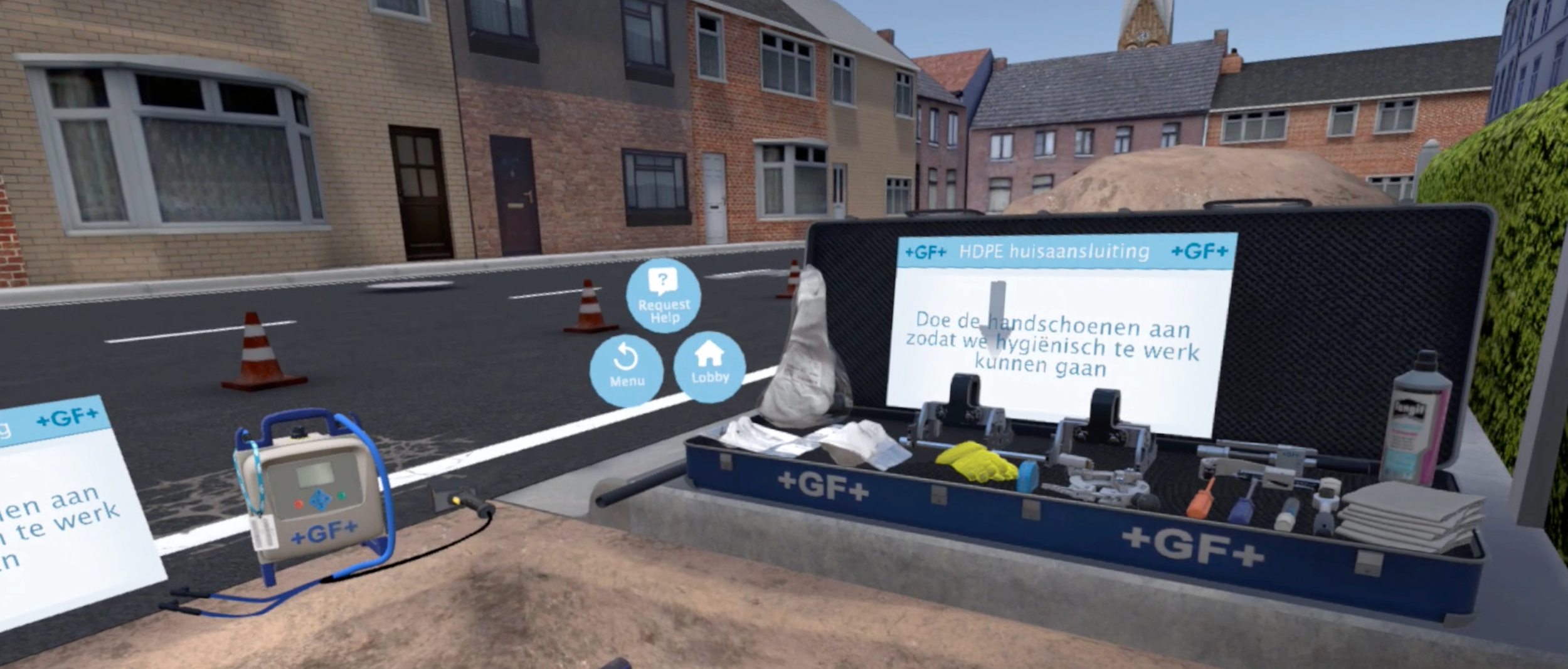
In many today’s virtual reality (VR) trainings such a technique is not applied. Additional cues such as highlights or arrows pointing to the right tools, materials or target actions—academically referred to as signaling—usually appear at the start of a new step and are presented together with textual or spoken instructions. This allows a trainee to walz through the training, but what they are actually doing is blindly grabbing, placing, and handling whatever the VR environment conveniently highlights. This is exactly what we found possible in trainings that we tried out and wanted to improve at the start of our collaborative TETRA project ExperienceTwin, together with Georg Fischer Piping Systems and SupportSquare.
Having ploughed through multiple academic resources looking for design guidelines on the timing aspect of signaling, we quickly realized that very little has actually been written about when such guidance should appear. This called for a new study!
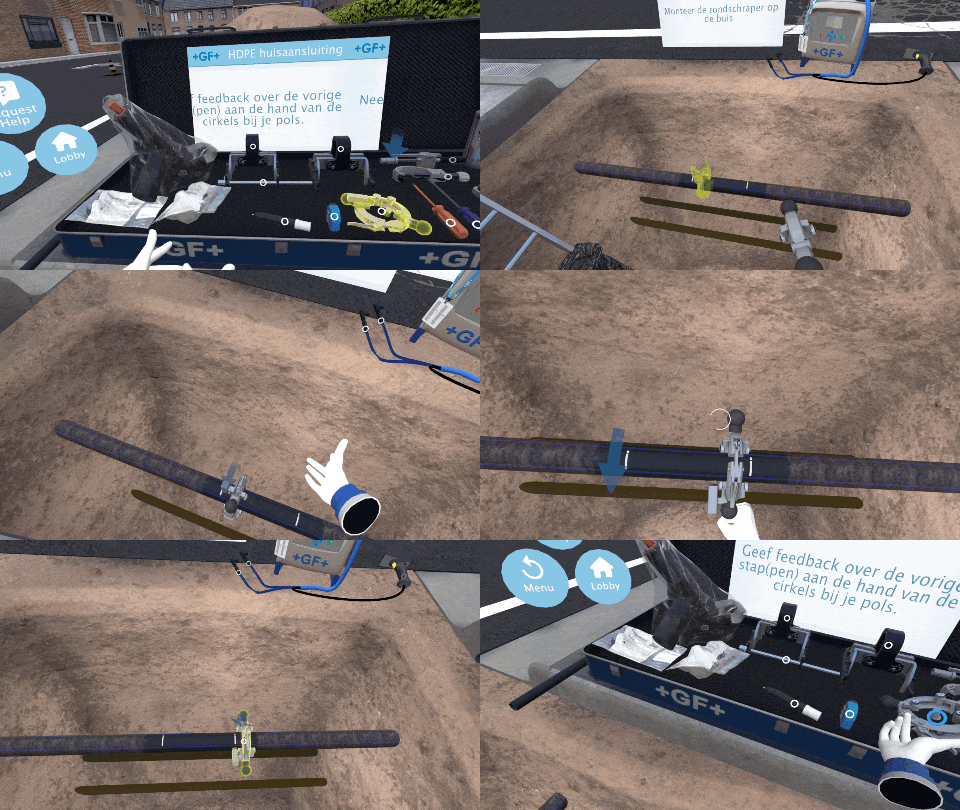
In literature, among other theories and design guidelines for multimedia learning, we observed a theoretical tension between two influential theories: discovery learning and cognitive load theory. Put shortly discovery learning favors limited instructional guidance to foster active knowledge construction and exploration, whereas cognitive load theory stresses the importance of guidance to reduce unnecessary mental effort that can complicate learning. From this tension, we proposed a way out: delayed signaling. Delayed signaling would allow trainees to first explore on their own, try things out, and only receive help when it is actually needed (here, when they cannot execute the correct action within reasonable time).
Delayed signaling can be seen as an intermediate step between where we are now and where we, in my opinion, should be heading: adaptive signaling. In adaptive training systems, a trainee would receive additional help at the exact moment when it is needed based on objective metrics (e.g., psychophysiological measurements). While we are not there yet, the present study serves to guide future research in that direction and provide useful insights on the road toward adaptive training systems.
Back to the present work. Together with the two company partners, we joined forces to explore and test whether delayed signaling improves learning. In our experiment, trainees followed a VR training on electrofusion welding, particularly a complex, safety-critical procedure used to connect a house to a pressurized water line. One group trained with immediate signaling, where arrows and highlights appeared right away. The other group trained with delayed signaling, where these visual aids only appeared if trainees took too long to find the correct object or action.
Here comes the interesting part. When trainees later repeated the task without any visual cues at all, those who had trained with delayed signaling completed the procedure faster on average. They also located and manipulated the correct tools more quickly, suggesting stronger procedural learning. Importantly, this improvement did not come at the cost of higher cognitive load: trainees did not report feeling more mentally strained, either during training or during the final test. In short, letting trainees struggle just a little—before stepping in with guidance—helped them learn the procedure more effectively.
Timing, it turns out, is not a minor footnote but a powerful design lever in VR training. Our findings suggest that something as simple as when we show arrows and highlights can make the difference between trainees merely waltzing through a training and actually learning skills that stick.
This blog post aimed to provide a high-level overview of the study, its underlying rationale, and its main findings. The journal paper tells the full story: it elaborates on the theoretical frameworks underpinning the work (including discovery learning and cognitive load theory), details the experimental design and technical setup, and reports on the full range of measures used—including exploratory metrics such as Time to First Fixation (TFF). The results are interpreted in a nuanced manner and integrated into the broader literature on multimedia learning and immersive VR training.
Please find the full paper here.